Hyperpersonalization in customer service: the conversational interface is just the beginning
In the insurance industry, everyone talks about putting the customer at the center. But what does that actually mean in practice? It’s not a slogan—it’s a concrete need: fast, accurate, and effortless service, regardless of the product, contact channel, or department involved. Customers, including brokers as key distribution partners, expect a consistent and efficient experience. That’s what determines whether they stay longer, renew their policy, and recommend the brand to others.
What’s worth knowing:
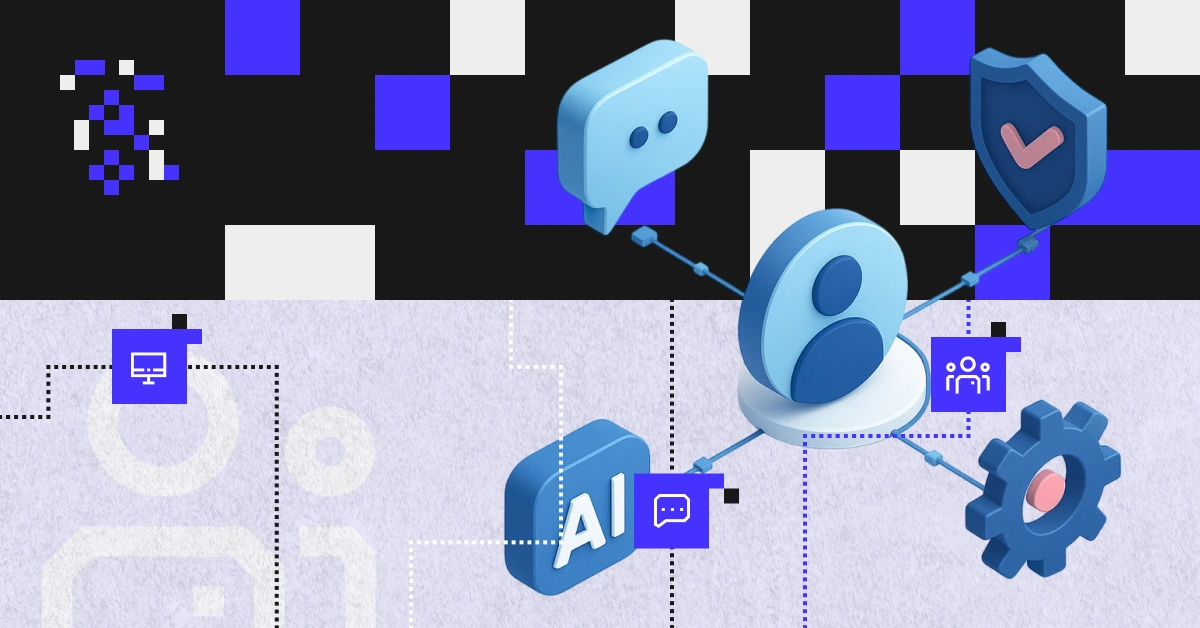
- Data is the foundation of hyperpersonalization. Without a unified view of the customer, even the best technology won’t deliver a consistent experience.
- A chatbot is only the beginning. Real value emerges where the conversational interface connects with backend processes and data.
- Personalization is a strategic—not a marketing—decision. It requires organization-wide thinking, from data management and system architecture to team collaboration models.
Why it matters
Customers no longer want just “insurance products.” According to the Accenture Insurance Consumer Study 2023, as many as 60% of customers are willing to share personal data in exchange for faster and easier processes such as claims handling or policy updates.
The message is clear: technology is not an obstacle, it’s an expectation. Where responsiveness, personalization, and understanding are missing, customers feel like case numbers, not partners. That’s a direct path to losing trust—and business—among both retail clients and brokers.
Unified customer service
No customer wants to think about how many systems or people are involved in resolving their case. They expect one consistent answer—ideally, right away. That’s why integrated service is essential, working seamlessly across contact channels, products, and organizational structures.
Example: A customer reports a claim and also wants to update their contact details. For them, it’s a single issue, not two separate paths, forms, and departments. They expect one interaction—and for the rest to happen in the background.
In practice, this means:
- one customer record—up to date and complete
- one entry point—available via chat, email, phone, or app
- one goal—a quick, effective response and resolution
For the organization, this is a signal to treat customer service as a continuous process, not a series of isolated stages assigned to different teams.
What drives effective hyperpersonalization
Many insurers start their personalization journey by implementing chatbots or voicebots. It’s the most visible element of change, making service feel more accessible, faster, and modern.
But a truly personalized experience goes far beyond automated conversations. It’s the outcome of several core components—technological, process, and communication—working together to genuinely respond to customer needs.
1. Conversational interface
Natural language is now the most convenient form of interaction for customers, whether through phone, email, mobile app, or website. A conversational interface enables a consistent dialogue across all channels, recognizing customer intent and needs in real time.
It allows:
- case submission without choosing from multiple forms
- consistent experiences regardless of the contact channel
- guiding the customer through each step until completion
2. Dynamic product portfolio
An insurance company needs a flexible, modular product model that allows for quick adjustments to evolving market demands and to B2B and B2C customer expectations.
That means:
- the ability to rapidly configure sales product variants
- tailoring coverage to specific customer needs
- responding swiftly to new market demands without rebuilding the entire product offering
3. Business process orchestration
Behind every fast, automated response lies a process management system that enables smooth progression through all stages of service—from initiation to verification to completion.
Key enablers include:
- automation and standardization of repetitive actions
- leveraging technology – including AI – to support decision-making and contextual responses
- the ability to modify process paths quickly without engaging IT
- process monitoring, bottleneck detection, and prediction
Customer service is an ongoing process of optimization, continuously adapting to new expectations and market conditions.
4. Consistent and standardized data
Even the most advanced front-end won’t perform well if it relies on fragmented or outdated data. That’s why the foundation of modern service must be a unified customer profile that consolidates information from multiple sources—CRM, policy systems, claims handling, communication channels, and analytics platforms.
The so-called Golden Record enables:
- consistent communication across all channels
- customer profiling and product recommendations
- minimizing errors caused by inconsistent data
- real-time decision-making and service without searching across multiple systems
Without this foundation, personalization remains superficial – limited to isolated touchpoints, impossible to scale or sustain consistently.

Technology is just a tool
Hyperpersonalization requires organization-wide thinking—from data and processes to products and collaboration models. And while a chatbot may signal change to the customer, real value lies deeper: in unified service, flexible offerings, and the ability to act quickly based on real-time data.
It’s a complex task that calls for breaking down silos, sharing responsibility, and thinking beyond structures—not just in IT, but also across business, sales, and customer service. Yet with a well-defined strategy and actionable roadmap, these barriers can be overcome. Today’s solutions, including those powered by generative AI, make it possible to implement change faster, more effectively, and at scale.
In the era of digital transformation, customers are sending a clear message: “We’re ready to share our data if you give us a better experience.” That’s not a declaration—it’s a condition for continued partnership.
Now the next move belongs to insurers.
This article was originally published (in Polish) in “Gazeta Ubezpieczeniowa,”, issue 21/2025, May 27, 2025. Electronic edition available here: https://gu.com.pl/hiperpersonalizacja-w-obsludze-klienta-konwersacyjny-interfejs-to-dopiero-poczatek